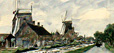

Entrance
to Anvers
port
1866
to Anvers
port
1866

|
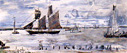
Entrance
to Anvers port 1866 |
|
|
| SATIE - Gnossienne N° 4 (1891) |
Jongkind was born in Lattrop, in the eastern part of The Netherlands, in 1819, eightht of a family of ten children, but will spend his childhood in the harbour of Vlaardingen on the Meuse River, the west of Rotterdam harbour, where his father was appointed as tax collector. In 1835, he lives school to work as a junior clerk at a
notary's office.
In 1845, he will be noticed by Eugène Isabey, the leader of the French Romantic school, who is in The Netherlands and invites him to become his student in his Paris studio. At the same time Jongkind is recommended to the Prince of Orange (future Guillaume III) who grants him subsidies and the necessary allowance so that he can go to Paris (this grant will end in 1852). Jongkind takes French lessons which, all his life and in spite of the number of years spent in France, he will pronounce and write with a lot of fantasy!
Jongkind arrives in Paris in March of 1846, deeply impregnated with this cumbersome inheritance as a dutch landscape painter. He will work in the workshop of Isabey, and study in the studio of Picot. He will also get acquainted with many painters, especially Barbizon School's painters. Surprisingly, when one would expect him to paint the Paris of monuments and wide open spaces, he will apply himself to paint close-up views of Paris, slices of life he observed. Jongkind looks at Paris with an acute and new eye, and his painting evolves with a new langage, new ranges of color and light, and a research for pictorial representation of light.
Jongkind sets up a new way of working : outdoors, he draws quick watercolored sketches, where colored touches allow him to seize instantaneous impressions, that he possibly annotates with handwritten comments. Then, he will later compose in his studio a more elaborate and constructed painting based upon several of these sketches as well as his memories. He innovates too by getting a brighter palette and by introducing in his paintings small strokes of various colors to translate the analytic decomposition of light and to better render changing effects (reflection, heavens...) All throughout his life, Jongkind will keep on painting Paris, of which he will write, once he had returned to his country (between 1855 and 1860), : "It is Paris where I am recognized as a painter". But he will also, during this first stay in France, fell in love with the Norman Coast that he discovers in 1850 while travelling from Dieppe to Le Havre with Isabey. He will exhibit "View of Harfleur port " at the Salon of 1850, that will be unanimously appreciated by art critics. After his mother died in 1855, Jongkind goes back to Holland and lives in Rotterdam, where he will return to more traditional paintings. Until his return to Paris in April 1860, he corresponds with his art dealer, the Père Martin. Jongkind will send him paintings to sell, and Martin will regularly send 100 francs notes to Rotterdam. On Comte Doria's initiative, with the help of painter Adolphe-Félix Cals and Père Martin, a sale by auction of works of 88 artists including Corot, Isabey and Rousseau is set up on 8th of April 1860 to the benefit of Jongkind, in order to make his return to Paris possible.
Jongkind is back to Paris and will then live in France until the end of his life. He settles 9, rue de Chevreuse (today 5), in the area of Montparnasse, in an apartment that he will keep until his death. Soon, at the Père Martin's store he becomes acquainted with a Dutch painter, Mrs Joséphine Fesser, with whom he falls in love and who will become his partner. Weakened by his melancholic disposition, familiar with brothels and filles de joie, always short of money, Jongkind will find with Joséphine a strong woman who was to help him to overcome his difficulties. She will also have him visit the country, especially, as soon as 1861, the Nivernais area where he painted "The ruins of Rosemont castle " that will be exhibited at the Salon des Refusés of 1863. In 1862, Jongkind gets acquainted with Boudin and Monet, with whom he goes painting to Le Havre. Monet will later express his debt to Jongkind by writing that he became, after Boudin, his master and that "he completed the definitive education of his eye".
It is this Norman period of Jongkind which situates him as the precursor of Impressionism that he will remain in regard of art history. His friendship with Manet and Monet during his sojourns at the Saint-Siméon farm in Honfleur, where they will found a school, also entitles him to this designation. But, from that time, it is his entire work, not only his seascapes, which deserve this qualification, even when he is painting far from the sea, in the Nivernais or Dauphiné areas.
Jongkind will then have a good reputation in France, he is idolized by young people, and his works, sunsets, seascapes, moonlights, are much sought after by art collectors. Every fall, he returns to Belgium and The Netherlands.
The franco-prussian war of 1870 will drive Jongkind and Mrs Fesser far from Paris, in Nantes then in Nevers.
Gradually, he will take his distance with parisian life, definitely settling down in 1878 in the house Mrs Fesser's son bought in la Côte-Saint-André, a small village in the Dauphiné area near Grenoble. There, he will lead a quiet life until the end of his life, except for a few trips in Provence and regular sojourns in Paris, where he comes every winter to work.
|
Painter Paul Signac reported that Jongkind paintings were so much looked for during the Salon des Refusés of 1879, that forged copies of his works would be sold at high prices .
 JONGKIND WATERCOLORIST
After Jongkind's death, the exhibition of 134 of his watercolors during his second workshop sale, and several several following sales devoted to his watercolored works had a great success and prices would reach up to 5000 francs for La Seine à Argenteuil .
|
Whereas the genius of some artists is sudden, that of Jongkind is constant over a long period of maturity, whatever the subjects and genres he approaches. Especially he will contribute to make watercoloring an art by itself. |
|
Looking back to Jongkind work which is so diverse, one is struck by the fact that whereas the artist moved in France where he will look in a new way to Paris streets or Normandy, he nevertheless remains faithful to traditional themes of his native country. Jongkind was thus able to adapt himself to new landscapes by developing a different painting, while continuing his former works, which shows how much he mastered his art.
The caliber of the artist is so important, that from the beginning, Holland, his native country, and France, his country of adoption, quarrel over Jongkind . Johan-Barthold Jongkind is buried near Grenoble, in France, in the cimetery of la Côte-Saint-André.
Many works of JONGKIND are kept by the Institut Néerlandais of Paris (close to the Assemblée Nationale).
Chronology
|
1819 |
Birth in Lattrop, Holland |
|
|
1835 |
Works as a clerk in a notary's office |
|
|
1836-1837 |
Death of his father |
|
|
1837-1845 |
Training as a traditional Dutch landscape painter, inspired from masters of the "Dutch golden century" (Vermeer, Steen...) |
|
|
1845 |
Obtains a 200 florins grant from future Guillaume III |
|
|
Meets with Eugène Isabey who is travelling in the Netherlands |
||
|
1846-1855 |
Comes to Paris to work in Isabey's studio,
where he will stay for 10 years |
|
|
1847 |
First journey to Le Havre |
|
| 1848 |
First exhibition at the Salon de Paris |
|
|
1850 |
Travels at Dieppe, Fécamp and Etretat
with Isabey shows "View of Harfleur port " at the Salon, most appreciated |
|
|
1851 |
Travels in Normandy and stays at Le Havre with Isabey |
|
|
1852 |
Gains a medal at the Salon |
|
|
1855-1860 |
Returns to Holland and lives in
Rotterdam |
|
|
1860-1878 |
On Comte Doria's initiative, helped by Cals and Père Martin, an auction of works of 88 artists, including Corot, Isabey and Rousseau is set up to the benefit of Jongkind to have him back to France In 1860, he meets in Paris with Joséphine Fesser, a Dutch painter, who becomes his partner and helps him overcome his difficulties Many trips in Nivernais, at Le Havre, Honfleur, Brussels and in Holland In 1862, he meets with Boudin and Monet Goes every summer on the Norman coast between
Trouville and Honfleur, where he meets with his friends
Bazille, Monet, Corot...at the Saint-Siméon farm
owned by " la mère Toutain" |
|
|
1861 |
Settles 9 (today 5) rue de Chevreuse in
Paris, in Montparnasse area, far from Montmartre cafes, in an apartment
that he will keep until his death. |
|
|
1862 |
Paints with Boudin and Monet in Le Havre. Monet will write that Jongkind, after Boudin, became his teacher and that he "completed the definitive education of his eye" Baudelaire writes a laudatory article about Jongkind's etchings |
|
| 1863 | Exhibits "Ruins of Rosemont castle" at the Salon des Refusés | |
| 1868 |
Works on a series about Demolitions
of Paris |
|
|
1873 |
"Moonlight in Rotterdam"
is rejected at the Salon. Jongkind decided to cease submitting
paintings at the Salon |
|
|
1878-1891 |
Lives with Mrs Fesser at la Côte-Saint-André near Grenoble, where Mrs Fesser's son has bought a villa, that he will leave only for a few trips in Provence and every winter season to work in his Paris's studio. His palette gets even brighter and his paintings' construction gets more simple
|
|
|
1881-1891 |
Gets more and more customers, and prices of his paintings get higher |
|
|
1891 |
His psychological state worsens (melancholy,
paranoïa), which leads him back to alcohol. He dies in Saint-Rambert
hospital near Grenoble |
|
|
 |
|
 |
|
 French
version
French
version